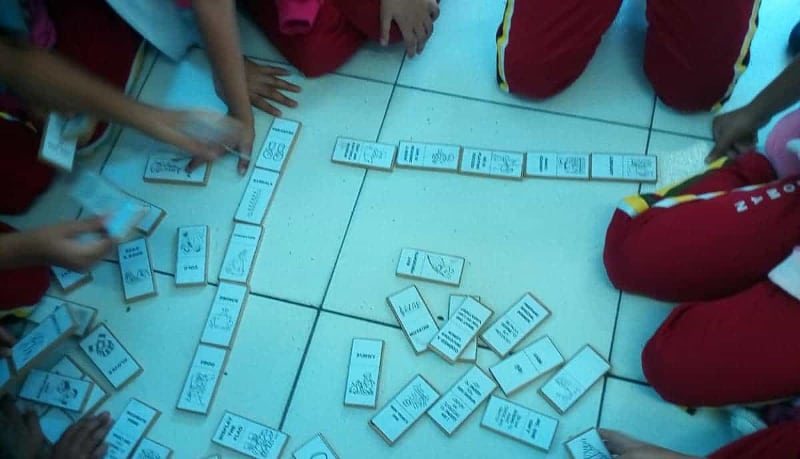
Many people think using ESL games in the classroom is a trivial time-filler. However, teachers experienced with games will tell you otherwise. In fact, English games, when used correctly, take the stress out of learning a language and help pupils succeed by learning naturally.
Why People Do not Like Games
According to Lloyd Rieber, author of Seriously Considering Play: Designing Interactive Learning Environments Based on the Blending of Microworlds, Simulations, and Games, ‘it is somewhat surprising that one of the most fundamental and important concepts of human interaction has received so little attention.’ He goes on to explain how misconceptions about play foster this attitude. For example, people view work as respectable and play as easy. Therefore many people balk at pupils playing ESL games in the classroom – it is not respected or rigorous enough to be useful. However, this view is wrong since many of the things we “play” can be challenging, like puzzles, chess, sports, and music.
How Pupils Benefit From English Language Games
What people don’t realize, however, is that many people have different learning styles. Henry Gardner explains this through his theory of multiple intelligences. Most people do not function well under the typical range of intelligence used in schools (including verbal/linguistic and logical/mathematical skills). As Dee Dickenson reports in Learning through many kinds of intelligence, using games helps pupils access different learning styles. These types of intelligence include visual/spatial, bodily/kinesthetic, musical, interpersonal, naturalistic, and intrapersonal. When pupils have opportunities to learn using their preferred styles, they are often more successful at learning any subject.
Furthermore, as reported on FamilyEducation.com, ‘Probably the most important developmental benefit is that games require children to interact and speak with each other. They have to negotiate rules, take turns and correct and challenge each other.’ This challenge helps pupils use and improve their thinking, problem-solving, listening, and speaking skills.
What Pupils Think
Nguyen Thi Thanh Huyen and Khuat Thi Thu Nga, authors of Learning Vocabulary Through Games: The Effectiveness of Learning Through Games, conducted a study exploring games. They focused on whether games improve vocabulary acquisition. This study gathered pupil reactions to games and found positive results. For example, students liked the relaxed atmosphere, the competitiveness, and the motivation that games brought to the classroom. Pupils also reported that they enjoyed using their imagination and creativity. During games, they learned new vocabulary ‘but also were forced to recall existing knowledge and put it to use.’
What Types of Games are Best and Why
In her article All Play and More Work, Sally Flood explains how games are beneficial IF suitable activities are used. She highlights four necessary components: competitive elements to engaging content, reward, and relevant content. If the game lacks one of the first three elements, the pupils might not be motivated to participate. On the other hand, if you leave out the last element, the game won’t teach the topic at hand.
When Games are most Effective
For advanced pupils, games are great when you or pupils need a break from intense studying. They are also helpful in introducing a new topic or recalling or reviewing a recent lesson. With beginners, you can use games most of the time. It is possible to teach the year’s curriculum exclusively using games backed up by one written exercise or activity sheet per lesson. The written record gives pupils a history of what they have learned. I should hastily add that you can also use a writing game instead of an exercise or activity sheet.
Games are a great component to include in your classroom repertoire of activities because they allow pupils to explore different learning styles and learn the proposed topics at the same time.
ABOUT THE AUTHOR:
Shelley Ann Vernon, conscious of the vital role teachers can play in the lives of their pupils, promotes learning through encouragement and fun. Her teaching always involves games in the ESL classroom.
RECEIVE GAMES AND INSPIRATIONAL IDEAS FREE!
Choose to receive free games and tips for any of the following categories; one to one, preschool, primary, and teen-adult. English Language Games
Games in the ESL Classroom
-
Sale!
 Games
GamesGames and Activities for Teens and Adults
Rated 5.00 out of 5€19.97Original price was: €19.97.€15.33Current price is: €15.33. Add to cart -
Sale!ESL Tutoring
Teach Your Child English
Rated 0 out of 5€19.97Original price was: €19.97.€15.33Current price is: €15.33. Add to cart -
-
Sale!Games
ESL Games book for primary & middle school children
Rated 5.00 out of 5€19.97Original price was: €19.97.€15.33Current price is: €15.33. Add to cart