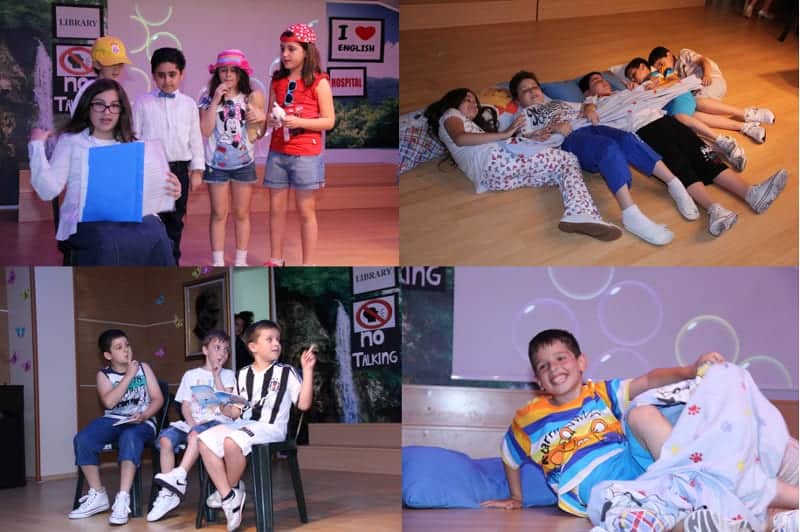
Video showing my ESL role plays
Hear how using drama helped Olga:
‘My name is Olga Poshekhova and I’m from Russia. I started teaching English only a year ago and, as you can imagine, didn’t feel confident at all.
Your ESL role plays helped me so much!
Thanks to them, my pupils and I had a wonderful year full of joy, surprises, and fun!’
Olga Poshekhova, Moscow, MoMiMo English Language Workshop
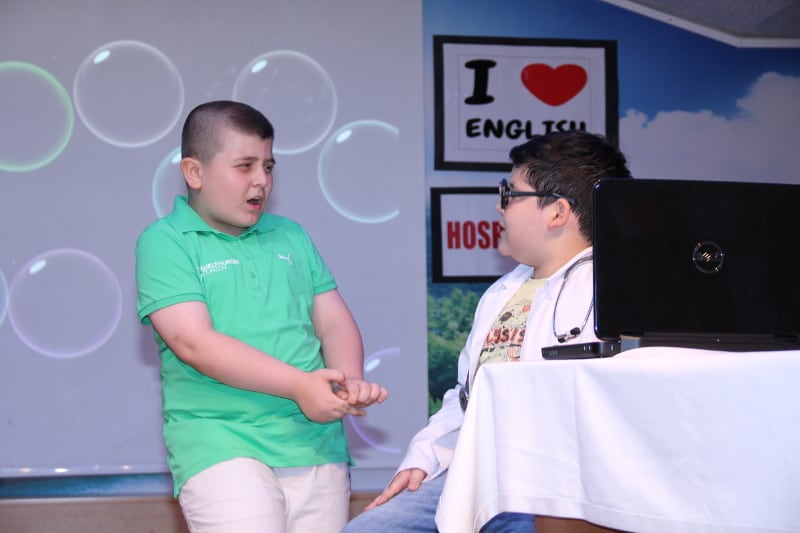
Why do some teachers avoid ESL Role Plays?
ESL role plays are so effective with small groups and one on one that all teachers should try them. However, here are four reasons why teachers shy away from drama as a teaching tool:
“Plays look like too much fun; where’s my textbook? Learning English should be laborious and hard work.”
“The children will make too much noise, and I won’t be able to control their every word and move.”
“I don’t have time for that; I’ve got 26 units to get through this term!”
“I can’t use ESL role plays to teach English because I can’t act!”
Great reasons to use ESL Role Plays now
The most effective way to teach ESL children is to provide them with opportunities to learn English in the context of everyday situations with an emphasis on communication skills. An ESL play does this efficiently, effectively, and with a large dollop of fun thrown in as a bonus, which means the children will look forward to their next lesson.
Young children use drama naturally
They are often in the land of make-believe: “This is our house, and this is the baby, she is just born, and she has to sleep now.” They assign roles and direct the action: “I’ll be the mummy, and I’m going shopping. You’re the daddy; you have to go to work!” And they slip in and out of multiple roles: “Now it’s my turn to be the teacher.”
Older children love being part of something
Preparing an ESL play together is a bonding experience for the group. All children are involved, from the shyest to the most outspoken, contributing to the final outcome. Children want to belong, and being part of a play allows that to happen.
ESL role plays & skits can effortlessly save you time
Drama is not an addition to your 26 units but a method of teaching them more effectively. It does not matter if you can’t act; the children will be doing the acting!
Children love them, parents love to be involved watching them, and your school will be happy too.
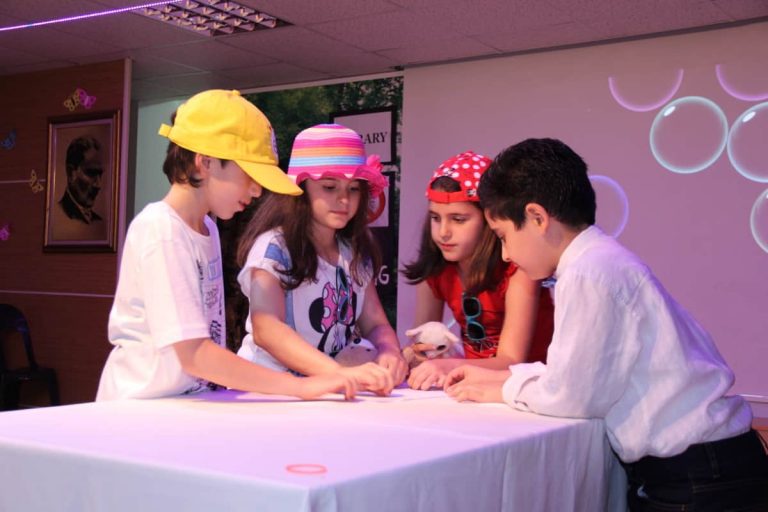
The hidden benefits of ESL drama
Aside from the direct benefits of learning English, which we’re going to look at lower down, creative drama makes students more skilled and rounded individuals. One of the findings of a three-year study funded by the Guggenheim museum in 2006, Teaching Literacy through Art, showed that including arts education increases fundamental literacy skills in elementary school students. Students involved in these programmes also “scored higher on expression, risk-taking, creativity, imagination and cooperative learning.“
ESL role plays and skits provide practical experience in communicating. They give children the opportunity to learn to work together and be part of something, belong to a group, and develop tolerance and empathy as they begin to see the world from different perspectives. ESL role plays promote active learning, which enriches and reinforces traditional school experiences. In addition, most children are excited by the prospect of performing and having a chance to be the center of attention. So, when it comes to teaching English as a second language, no matter the student’s age, drama and children are a winning combination.
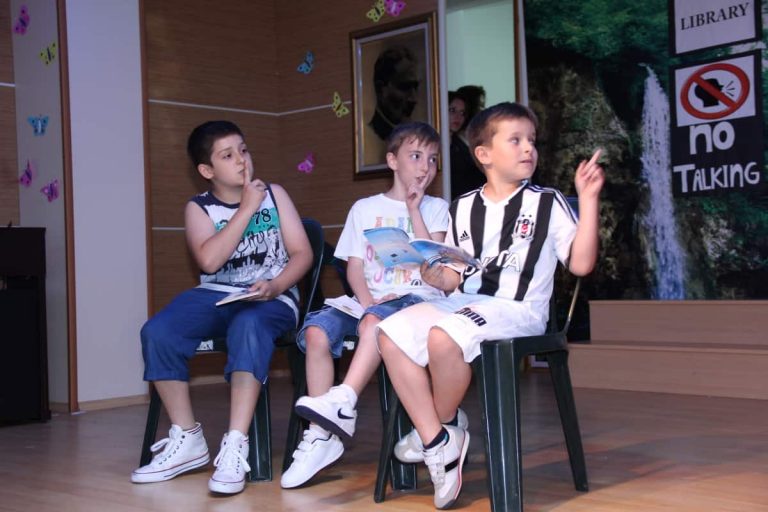
Benefits of ESL role plays for teaching English
Authenticity
First, it’s authentic. Using drama enables children to use English appropriately in real conversations. Second, English is taught in context, which makes students aware of the language as a means of communication and is far removed from vocabulary lists, worksheets, and textbooks.
Fluency
The conversational use of language in an ESL role play promotes fluency. While learning a script, children listen to and repeat their lines over time. By repeating the words and phrases, they become familiar with them and can say them with increasing fluency.
ESL drama teaches children to enunciate their words correctly and project their voices when they speak, helping them to become clear and confident speakers.
Integration
Using drama to teach English also helps to improve the understanding and retention of language. For example, by the time a child has read, rehearsed, and acted out a scene focusing on the phrase ‘I’ve forgotten my…’ there is little likelihood of ever forgetting how to use it in context. The same would not hold true if the verb ‘to forget’ had been memorized by rote for a vocabulary test.
Motivation
The active participation required in an ESL drama lesson involves not only the intellect but also children’s imagination and emotions. By encouraging self-expression, drama motivates children to use language confidently and creatively.
Learning styles
Drama allows children to tap into different learning styles – visual, auditory, kinesthetic, and tactile. Hearing the lines, seeing the actions, feeling the props, acting out movements, and using expression all make the lesson a far richer one.
Mixed abilites
ESL skits are ideal for mixed ability groups. For example, children whose language skills are still very limited can say fewer lines but instead participate using nonverbal cues such as body movements and facial expressions.
Order the ESL Role Plays and Skits Here
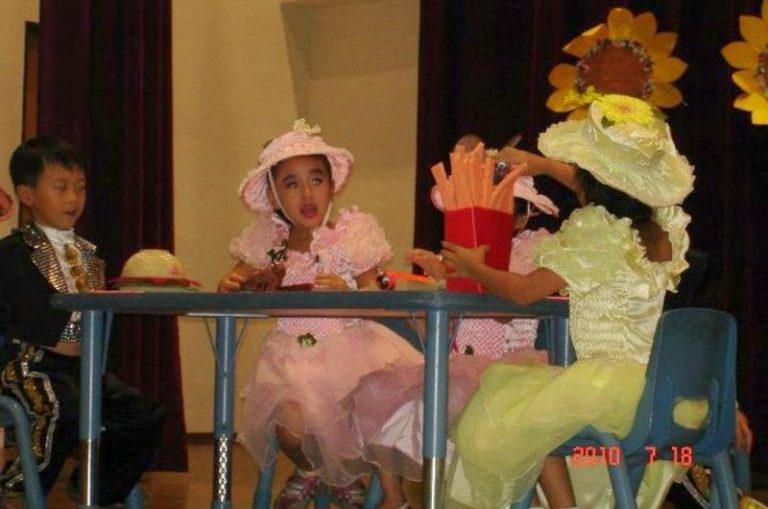
How ESL Skits Help With Student Motivation
Hear from Olga Keskin ELT Teacher Istanbul, Turkey
“I have been using your plays with 5-year-old kindergarten students, and the result is absolutely fantastic! They are not just having fun during the role-play; they have also started using the structures from the plays in various situations outside the classroom, at play-time, mealtimes, etc. The plays do get them to speak. And this is a very rewarding experience for us, teachers, to hear them speak, not just use the target vocabulary.
Teaching vocabulary has also become easier through your plays. Every single new word they learn is now more meaningful for the children as it is connected with their real-life experiences. I have also been getting very positive feedback from the parents telling me that their children like acting out these role-plays at home with their parents and toy animals. Thank you for this great material, Shelley. I’m Russian but teaching in Turkey.”
Olga Keskin ELT Teacher Istanbul, Turkey
Demotivation
As teachers, we all know that trying to teach an unmotivated child is like hitting one’s head against a brick wall. We seldom come across this problem with very young children as most kindergarten and preschool kids are motivated by curiosity and the love of exploring new ideas. Sadly, as a child grows older, learning is often seen as a chore. Let’s look at some reasons children become demotivated and see whether drama could be a factor in overcoming them.
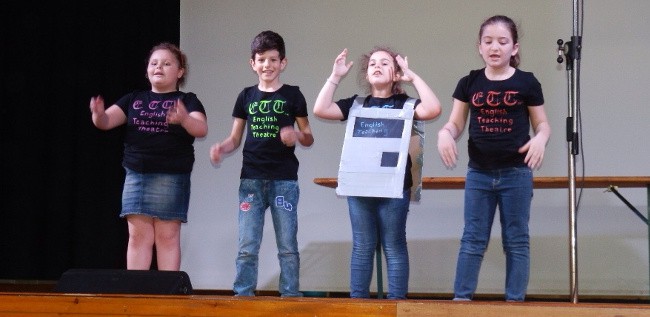
Universal success
The child’s experience of success or failure has a significant effect on their motivation to learn. If children repeatedly fail, even when they have put a great deal of effort into their learning, they are inclined to approach future tasks with a negative attitude. By using drama as a teaching method with the appropriate choice of play and roles, there is no reason why all children cannot experience success. The secret is to make the task challenging but achievable for each child.
Enthusiasum
The teacher’s own enthusiasm goes a long way towards motivating a child. Anyone who has taught a classroom of children knows how quickly they pick up and reflect your moods. If you think your English grammar lesson is boring, so will your students!
By using drama as a teaching method and allowing children to experience language in a play’s simulated reality, they will derive far more fun from the lesson, which increases motivation. In addition, the chances are that they will be confident enough to use the language in similar situations in real life.
Drama techniques motivate children to learn by breaking the monotony of the English lesson and lifting the tempo as children discuss and act out their roles, learn what they are going to say and decide how they will say it.
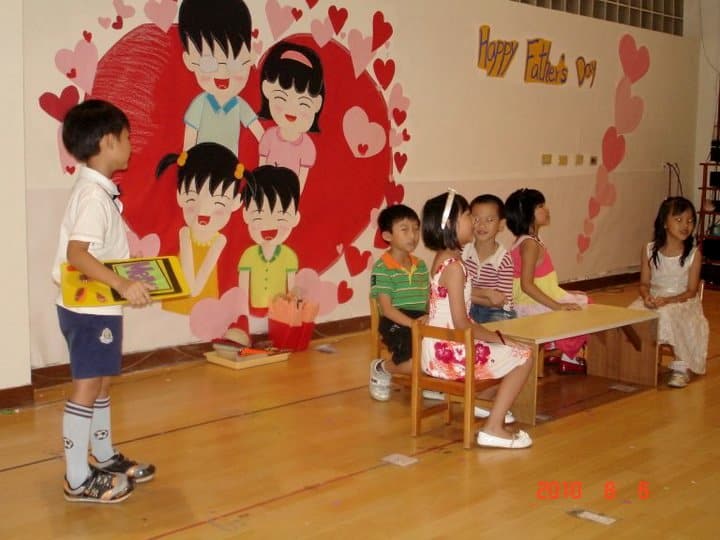
Belonging
Another factor concerning a lack of motivation is the child’s need to belong. Watch an apathetic child in the classroom come alive on the playing fields and play his heart out for his team. That is where he feels he fits in, his talents are respected, and he is part of the team.
In a drama lesson, all children are equally and actively involved; each role is essential for the successful performance of the play. A sense of belonging can be achieved here that isn’t easy to attain in a more traditional classroom setting.
Self confidence
Another crucial motivational factor related to success is self-confidence. For example, as children become familiar with their lines in a play, they become more confident in their use of language.
Even timid children, who generally withdraw from group activities and are shy about talking in English in front of their friends, will often come out of their shells when given a role which they can handle.
It’s natural
Role-playing comes naturally to children, especially the younger ones, and when playing a role, they quickly shed their shyness and inhibitions. As they discover that they can be anything, just by pretending, children grow in self-esteem.
The power of the persona: children who might otherwise be hesitant about speaking in public can often do so unselfconsciously when playing a part.
How to Get Started with ESL Role-Plays
Warm-up ideas
If you have not yet introduced your class to drama, there are many circle games that you can use to initiate dramatic play.
Theatre games
Violin Spolin’s Improvisational Theatre Games are a good way to start as they help the children relax, encourage them to use their imagination, and help them become more confident.
In one of Spolin’s games, the group stands in a circle. First, one child turns to the right and makes a simple movement. Next, the child on the right repeats the action and gives a new move to the child on their right. Continue around the circle until everyone has had a turn.
In addition, use this game with sounds. Start by making them non-verbal. As students become more proficient at this game, have the movements and sounds accumulate. Each additional sound and motion can eventually build the entire sequence into a form of dance. Finally, a verbal version of the game could combine the vocabulary you plan on using in a play with the movements.
Singing
Singing is also an excellent way to practise English. Once children know a song and enjoy singing it, put new words to the tune. Almost anything is possible. ‘Frere Jacques, Frere Jacques’ becomes ‘Eggs and bacon, for my breakfast’ without any trouble and is sung just as lustily! Put familiar tunes to phrases found in the play before you even introduce the script so that by the time you do teach it, students know the key vocabulary and phrases already. Have the children sing in rounds and encourage raucous participation.
Adapting the Play
Once pupils start to experience their ESL classroom as a fun and safe environment and begin to understand the basics of performing, it is time to introduce them to the real thing.
Choosing the script
Choosing an appropriate ESL role play script is vital. It should be not only age-appropriate but also suitable for your students’ language level. It is also important, of course, to ensure that the lines spoken in the play are in keeping with the particular language areas you are teaching at the time.
Keep the script simple, but develop it further or modify it if your students’ proficiency or lack of proficiency in English requires it. Some lines in the play may be optional. Edit these freely to suit your needs, based on the main idea. My ESL skits are written for beginners so, if you have intermediate students, you will learn them faster, or you can add extra lines to make them harder.
The plays on offer at the bottom of this page are written especially for ESL classrooms, for children aged 4 to 12 inclusive. They are short and repetitive and designed to involve the whole group, no matter how big or small.
Assigning roles
Assign roles according to your students’ language ability levels. For example, children who are more capable and more confident can be given more lines. In contrast, shyer children or those with a more limited vocabulary can have fewer lines, repeat lines said by other children, or speak as part of a group.
My ESL skits for kids fit any class size, including one-to-one. In addition, the preparation process means that all students know every line. The beauty of this is that if a child misses a rehearsal, or even the final performance, the show can still go on!
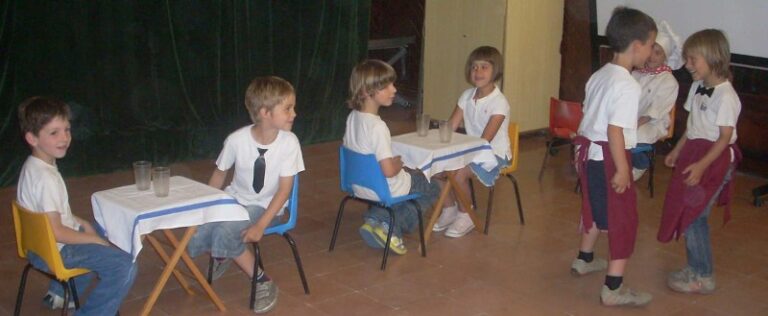
Pre-Teaching the Play’s Vocabulary and Phrases
Once you have chosen the play, it’s time to get down to the nitty-gritty of rehearsals. While older and more capable students can be given copies of the script to read, I do not advise this for younger and less capable children. For all students, no matter what level they may be on, the emphasis should be on speaking, acting, and movement, not reading lines. Again, it’s a matter of personal choice, but my recommendation is not to give out the script at all.
Pre-teach the vocabulary first
Use it in songs and games like Spolin’s circle game and those in 176 English Language Games for Children or the preschool games book; chant the words, stamp out the syllables, or act them out individually – this is fun when using words describing emotions and actions.
Now teach the key phrases
Once the children are familiar with the separate words, let them start practicing the lines in the play. For example, use games to practise short sentences. The idea is not to have individual children word-perfect in their own role but to let the whole class experience using the sentences and vocabulary in context.
Rehearse
Only when children know the key words and lines of the play should you put together all the elements – words, expression, and movement. Then, allow the children to use their creativity in setting the scene, deciding on props, costumes, etc.
Keep props simple
Remember to keep props and costumes very simple, using the ‘less is more’ principle, and only include them in the final rehearsals.
You will find that if you give the children props too soon, they can become absorbed by them and take a lot of time arranging them and so forth instead of getting on with saying their lines! Therefore, give out the props when the play runs fluently. At this point, the addition of props becomes a novel element to keep the children’s interest right through to the final performance.
ESL Play Performance
A final performance is crucial
It is vital to perform the play, even if it’s to the class next door because it allows the children to feel the satisfaction of showing their work.
If you give parents sufficient notice, they could arrive earlier to collect children from the last lesson of term. Alternatively, arrange a special time. For example, one can often perform the play during a school assembly or an after-school performance. School heads are generally proud to show off class accomplishments to parents, so even if you are a visiting teacher running after-school classes, the head of school still sees this as a benefit to offer to prospective pupils and parents.
Tip regarding the performance
Don’t start the show directly with the play. Instead, have pupils sing a group song or two with actions, play some vocabulary games in front of the audience as a warm-up, and finish with the play. This order helps kids get used to being in front of an audience. therefore, they are much, much less likely to freeze up with nerves when saying their lines.
Posters
Preparation of posters and invitations could form the basis of another English lesson. If the prospective audience has limited English skills, consider providing a translation. I was once asked for subtitles by a parent, which surprised me as the language in the play was so basic I thought everyone would be able to follow it. However, it is polite and helpful to acknowledge the audience in this way.
Video
Take a video of the play, if you can. Not only will the children love seeing themselves act, but it will also serve as helpful revision whenever the children watch the play. Furthermore, it will enable you to give them feedback later and provide you with a benchmark of progress. In addition, with permission, you can use it to market your lessons and attract more pupils. Finally, a recording of one of your plays is a testimony to your success as a teacher.
Feedback From Teachers
From Becky Good, in Battambang, Cambodia
The children in my beginners’ English class had such fun doing your free skit ‘Ready Steady Go!’ at their graduation last May that I was pretty well obliged to buy the book so I could propose another skit at the close of their summer session! They were begging me for a skit. ‘The Robot’ was perfect and so simple to do. It really helped the kids build confidence in their ability to speak English. Thanks for making us look good!
From Mihaela Ciontu
I am currently using the plays with my daughter, and she simply loves them. Now I noticed there’s a language trick in every script “Where are you going?/What are you going to buy? / Would you like versus Do you like?” They are smart choices, and my daughter loves playing them.
From Cristina Roig
Last week I did the play Ready Steady go! and The Restaurant with my class (5 year’s old) they loved it, we had a lot of fun, and the parents were astonished at their capacity to start speaking some sentences in English (it is, after all, their first year). Your material is fantastic!
A Free Sample Play For You To Try
Here is a sample play from the 30 ESL plays – Ready Steady Go!
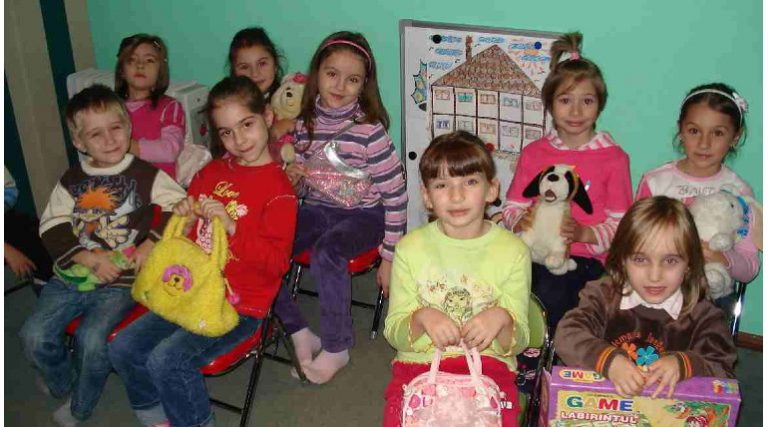
Andreevain Romania sent in a picture and wrote: “I played ‘Ready Steady Go!’ with my kids, and they liked it very much – here they are in the bus ready to go into the fantastic play world.“
Summary
Flexible Group Size
Teacher and pupil may perform every play one-on-one. In addition, groups scripts are adaptable to any number of children up to a maximum of about fifteen. The reason for the maximum number is to keep rehearsals flowing and to keep children heavily involved rather than waiting for a chance to say a line.
Funny Skits and Scenes
The plays are often written with a humorous twist at the end.
Tips
The introduction contains a lengthy tips section on how to organize rehearsals and teach the plays. A top tip is to pre-teach the main vocabulary and grammatical phrases before even reading the play. Another useful tip is to practise little and often rather than spend a whole lesson rehearsing. Finally, do everything from memory – no reading the script, or kids will never get away from the sheet of paper.
Immediate Access
My ESL skits are in PDF format, so you can download them instantly and pay no postage. However, if you would prefer a paperback, that format is also available. There’s no waiting, and you can get started straight away.
Consider these 30 plays as a curriculum to keep you occupied for at least a year of teaching, supplemented with games and songs, or fit them in with your coursebook. You’ll get so much pleasure from preparing these plays, and your private students or small groups of children will enjoy learning with you in this way.
You will be able to download the plays immediately on the processing of your order. I’m here to help if you need me.
-
Sale!
 ESL Tutoring
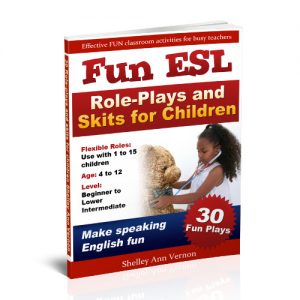
Fun ESL Role-plays and Skits for Children
Rated 0 out of 5€19.97Original price was: €19.97.€15.33Current price is: €15.33. Add to cart
-
Sale!ESL Tutoring
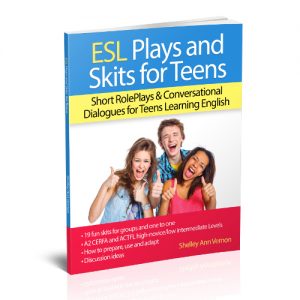
Plays and Skits for Teens
Rated 5.00 out of 5€19.97Original price was: €19.97.€15.33Current price is: €15.33. Add to cart
5 thoughts on “ESL role plays for children”
Hi there! I’m Ukrainian teacher and I really like your appoach towards role playing. I would like to buy your book but the price is too high for me. I will appreciate if you could send some scripts for my kids. Thank you!
Hello there Nataliya,
Thanks for your email. You could get the Kindle version of the skits. You don’t need a Kindle reader, Amazon have a free app that you download to your computer. The Kindle is much cheaper.
Here is a skit and lesson plan for kids:
https://teachingenglishgames.com/teaching-the-present-perfect-to-kids/
And here is a skit for teens:
https://teachingenglishgames.com/teen-skit-first-and-second-conditional/
All the best
Shelley
I bought your book; it’s wonderful. I have a question on teaching the script. I work with groups of 10-12 children, 9 and 10 years old. I’ve handed out photocopies of scripts in the past, but it turns into a crutch. Perhaps, for example, should I just have the class read the script together on the board and then divide them into groups and then I work with each group on their lines? I’m thinking about Role-Play 1, What We Want to Be. Thank you!
Dear Beth,
Hello there and thanks for choosing my skits book.
Firstly, have I sent you the videos and tips to get started?
I never give out the script, or write it on the board. Instead, I prepare kids using games. They learn all the vocabulary and key phrases in the skit using games. Then, we start to put it together as a group from memory, rehearsing short portions as short role-plays in pairs. Gradually we add more parts of the skit – all from memory. Finally, we add props.
Here is a lesson plan with the whole process, preparing for Ready Steady Go. I suggest that you teach this plan and do this skit first. Then, you can use the same method for all the skits, just vary the games each time.
https://teachingenglishgames.com/teaching-the-present-perfect-to-kids/
Next, if you have more than 15 kids in class, then this method would be better for putting the skit together – but only once you have taught all the language in the skit to the entire class:
https://teachingenglishgames.com/great-way-to-use-skits-with-middle-school-kids/
If you need more help – just ask ! And do send me a photo of your book, or any proof of purchase via email (see contact page on the site) and I will send you the videos if you haven’t had them yet.
All the best
Shelley
Hi, thank you for Role-Plays and Skits for Children. For the teaching the script, do you just write it on the board with the class? I’m thinking about using What We Want to Be with a group of 10-12 10 year-olds.