| |
 |
|
Brilliant!!!
It is amaizing how many games you can use in just one lesson. I can't
believe I am actually excited
about starting with the new unit. To be
honest I am extremely happy with these ideas. I haven't stopped
recieving compliments
on my teaching in the last week....
It
is the first time I am teching children so young and I can tell you I
am enjoying the experience very much. Now I see how a class
can be fun and
students can actually learn a lot. Thank you so much for
the inspiration.
And thank you for the wonderful
ideas for my lesson plans.
Fº
Javier Marín Millán
Spain
She
isn't like the other teachers, she teaches us while playing. It's
really fun and you
can remember it better.
Julie
Gambade, age 10,
Uriage, France
Warm
greetings from me, my coalegues and the Mkombozi Children. I hope I
told you that I am working with street children.
For my experiece, street
children cannot sit down for 40 minutes
and concentrate on the text books or on the blackboard or
listening to
the
teacher, because their life on the street mostly is to roam here and
there
almost whole day. But after
trying your games we found that the
children
like them very much as they keep them fun and enjoying the whole 40
minutes and demanding
to continue beyond the time set.
The
children were enthusiastic
and motivated
to participate fully. After
the
session I asked them how they felt about the games. They said, "Really
great." Teachers from other classes also shared with me what had happen
in their classes. They appreciate your games
and said that you deserve congratulations.
Amani
Masuki,
Mkombozi Center, Tanzania
|
|
| |
|
|
Fun ESL Game
for Children
All Change
Dear
Teacher,
Thank
you for subscribing fun ESL games for children, and ideas for teaching
English.
On
this page is the game All Change
AND
some free food flashcards to download.
CONTENTS
All Change
1. How to Play
2. Organising the
group
3. Language ideas to
use with this game
4. A few more
language variants
5. Materials for you
to use with this game
6. Reading and
spelling variant
7. Tell us what you
think
Category: Listening and understanding
Group size:6 to 30 children
Level: Beginners to intermediate
Materials: Picture or word flash cards
Age: 4 to 12
Pace: Wake up to Excitable
This game is designed to be used for several purposes:
1. when you have just introduced some new vocabulary and you
want to
reinforce it aurally before having your pupils start to use it
2. for revision
3. when you want to plant a grammatical structure in your pupils' minds
4. to expose children to reading and spelling when you use word flash
cards
instead of pictures
1.
HOW TO PLAY
Seat the players round in a circle, on chairs, or on the floor (on
cushions if you
have them), with one player standing in the middle. Each
player has a picture of an item, or a word flash card, except for the
player in the middle. Call out two of the picture card items
or words. The two players holding these cards have to change
places without the person in the middle grabbing one of their
spots.
If the person in the middle manages to sit on the chair, or the spot in
the circle then the one left standing goes in the middle. The
new person in the middle hands their flash card to the child taking
their place in the circle.
If someone is stuck in the middle for two turns say "All
Change!". When the
players hear this they must all change places, which gives the person
in the
middle a very good chance of joining the circle.
Once everyone has had one go ask your class to pass their picture to
the right, and take the one handed to them from the left. You
can give them another go with the new picture.
And it's that simple!
2.
Organising the group
With anything from six to fifteen children you can have only one
circle. With
sixteen to thirty children you would need two groups. Each
group should have the same picture or word flash cards so that the two
groups move simultaneously when you call out the words or
sentences. If you have different age groups or abilities this
is an opportunity to put all the older ones together, or all the
brighter/more advanced ones together.
One thing to bear in mind is that you need an odd number of children
per group - for example seven pairs in the circle and one child in the
middle.
If you have an even number then you can play too - starting in the
middle.
Alternatively you can pull out one of your best students to call out
the words or sentences.
It is very important, especially with larger groups, that you keep the
pace moving calling out the next change immediately the players have
swapped over. Do not give the children time to start chatting
to each other. Keep them on their toes.
3.
Language ideas to use with this game
The simplest version of the game is to call out two words, for example,
if everyone has a food or drink picture card you could say: "bananas
and pie". The child with the picture of some bananas, and the
child with the picture of some pie change places. (If they
can without the one in the middle taking one of their spots
first).
You can also incorporate the two words into a sentence such as:
"I like bananas and pie".
You can use more sophisticated sentences to match the ability of your
class and to introduce phrases you would like them to learn.
Here are some examples to give you the idea:
"I would like some bananas and some pie please".
"I like bananas but I don't like pie".
"Do you like bananas?...No, I like pie".
"Can I have some bananas and pie?"
"Where can I buy bananas and pie?"
"Do you have any bananas and pie?"
"I really love bananas but I can't stand pie".
"I feel sick when I eat bananas and pie".
There is/there are:
"In my kitchen there are bananas and apples".
"In my kitchen there is a pie and a banana".
You can see from the above examples how you can adapt the game to your
purposes.
You can be revising food vocabulary while introducing a new phrase to
them such as:
"You should eat bananas, but you shouldn't eat pie".
Alternatively, you could be revising a phrase while introducing new
vocabulary.
For example let's say you recently taught them the days of the week,
and now you are going to introduce food vocabulary. You can
say:
"On Mondays I eat bananas and pie".
"On Wednesdays I eat potatoes and sausages".
"On Saturdays I drink coke and milk".
"On Thursdays I drink water and I eat bacon".
And so on.
If you have an advanced class there is no reason why they cannot enjoy
this game from time to time, and you can use it in the same way
described above, simply use the grammatical structures you are teaching
them at the time, however complex. For example:
"I only wish I could have some bananas and pie".
"You ought to eat bananas and pie".
"How can you think of eating bananas and pie".
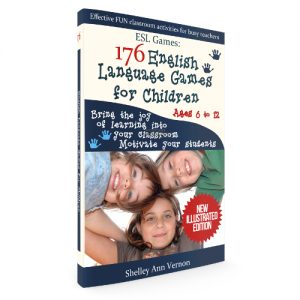
If you like this game, remember that there are 101 great games in my
book
101 Teaching English Games for Children. There are games for
listening like this one, and also many games for speaking practise, as
well as fun reading and writing games.
Just go to Fun
ESL games
to find out
more.
Or order
here right away.
4.
More language variants
Other vocabulary ideas for this game are: sports, “Next
weekend I’m going to windsurf and
play tennis”, or animals, “On my farm there are
pigs and sheep”, or professions, “My
mum’s a doctor and my dad’s a dentist”,
or places in town, “On Monday I’m going to the bank
and the supermarket”, or fairy tale vocabulary,
“The princess married the Martian”.
If you have a few star students who pick things up quickly you can give
them the task of calling out the sentences.
5.
Materials for you to try this game
You can use any pictures or word flash cards you may already have to
play All Change.
In addition I have prepared a set of picture and words cards for you
using food. You can download these free at the link further
down this page.
6.
Reading and Spelling
Please see sections 1-5 for how to play, for ideas on using
the game, and for where to get your materials.
Once your students have learned the vocabulary by heart, you can
practise reading and spelling by playing All Change with word
flashcards instead of pictures.
This allows the children to read the words and become familiar
subconsciously with the spelling.
7.
Tell us what you
think
We'd love to hear how you get on with this game.
Please send your comments, questions, and ideas for upcoming issues to
us through the contact form on this site.
Let us know what you want. Your feedback matters.
Copyright@2006-2009
by Teaching English Games. All rights reserved.
Free
flashcards
To
download please click on the link below and
save to your computer. It is a PDF document so you will need Acrobat to
read it. If you do not have this you can download it free. Type in "Download Adobe Reader" into google and you'll find it.
You can also use these flashcards in the many different games described
in 161 English Language
Games for
Children.
Download the full games
here.
Tips
on using the flashcards
Simply
print out the flash cards you would like to
use, and where necessary, cut them up with a guillotine type cutter. If
you want them to last a lifetime you can print them out on card and
then laminate them. You can then have them ready for use in other games
and for different groups of students. As you build your repertoire of
games and ready-made materials your class preparation time will be
dramatically reduced.
Have a great time with this game, and do let me know how you get on,
and what
else you would like to receive in these free monthly materials..
All
the best,
Shelley Vernon
Teaching English Games
|
|
|