An ESL vocabulary and grammar game for large classes
Here is a great game for large classes that I made up when responding to a teacher with 120 pupils in China!
This game for large classes needs no space or materials aside from pencil and paper.
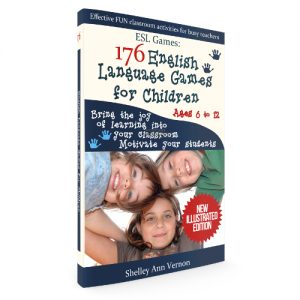
You’ll find it in my book, 176 English Language Games for Children. This game is a certified success, and you’ll be able to use it over and over for any language or target structure.
This game works!
Kids love this game for large classes, and it works really well, for real! So do give it a go.
It is always a problem, here in the Philippines, having 70-80 students per class. It’s really tough handling big classes in a limited space. I’m so glad that I came across your games. I have tried them in class and it was great fun, and my students have been motivated to speak. I handle senior classes, and they find the games very stimulating.
The latest game that I received from you is KIDNAP which is appropriate for big classes like mine. More power!
Ana Lorgie, Philippines for l
When to use this game for large classes
Category: Speaking, teaching grammar or vocabulary
Group size: Any size class
Level: Beginners to intermediate
Materials: Paper and pencil
Age: 5 to 12. Playable by teens & adults
Pace: Wake up – controlled and fun
I suggest teaching Kidnap in stages, using demonstration wherever possible. For example, to break up the rules into two simple steps, start by passing pictures as described in the ‘How to play’ section below. Then, once students complete that part of the game, add the ‘kidnap’ papers. Teachers have reported that children adore this game, so it is worth learning and regularly re-using for different vocabulary, grammar, and revision.
Setup
Divide the class into teams, which do not have to be exactly even, and name each one. Next, draw or stick vocabulary pictures on the board. Tell each child to copy one of these pictures and ensure that all the images are being drawn more or less equally. One way to do this is to number the pictures on the board and give a number to each pupil. For example, if there are twelve flashcards, give every pupil a number from one to twelve. Pupils draw the picture their number corresponds to. Use words instead of images when practising a sentence with a target structure, but pictures are much more effective for working on vocabulary.
Then, children write their team name on the picture. While children draw, write out the team names in a column and allocate nine lives to each team. Each time a team loses a life, rub one off the board.
Example chart
Here is an example chart, with the team name and number of lives:
The Pixels 1 2 3 4 5 6 7 8 9
The Vampires 1 2 3 4 5 6 7 8 9
The Dudes 1 2 3 4 5 6 7 8 9
The Geeks 1 2 3 4 5 6 7 8 9
The Ghosts 1 2 3 4 5 6 7 8 9
By now, each student has a piece of paper with a picture on it. Ensure that students have written their team name on the paper. Next, ask students to each take a second piece of paper. But, only one pupil from each team draws a square on it, pressing lightly, so the pencil line does not show through on the other side. The other pupils leave their paper blank. Everyone now folds this second piece of paper in half.
Now everyone passes the folded papers around until no one knows who has the ones with the square. Then, pupils look secretly at their folded paper to find out if they have the square and don’t tell anyone if they do.
How to play
Now everyone is ready to play. Call out one of the words, such as ‘bananas.’ All those with a banana picture hold up their hands. Pick one. That student stands up and is the collector of all the banana pictures. Do the same for another item, such as milk. You now have two students standing: one will collect all the bananas and the other all the milk.
Give the word or sentence that is to be repeated on passing a picture. A picture can only be passed when this word or phrase is spoken; otherwise, it’s cheating. Repeat the chosen vocabulary or say short sentences such as ‘I like bananas’ if passing the bananas. Anyone with a banana picture passes their paper in the direction of the collector, while the milk simultaneously travels to the milk collector. Everyone passing a picture must say the given word or phrase to the person they hand it to.
Tips
•Have a rule that the paper cannot travel diagonally but can only go up or across rows to include the maximum number of people.
• After a few goes, ask if anyone has not yet had a go at all. Specify that the paper must go via those who have not had a turn for the next round. Ask them to stand up so they can be identified.
• Whispering or murmuring will keep a lid on the noise. Anyone saying anything other than the given vocabulary or phrase loses a life for their team. So rub out one of the lives you drew on the board earlier.
• Exploit this game for any language. It’s excellent in that everyone has a chance to speak and drill themselves in the given words or phrases while having fun.
The kidnap papers
Now, here’s the snag! Pupils with a square can kidnap a picture and take it out of the game. If anyone succeeds in doing this, they shout ‘Kidnapped!’ Then, they tell you the team name on the paper they have intercepted. This kidnapping is the equivalent of a team member being taken hostage, and that team loses a life. Older children can also write their names on their paper, along with their drawing and team letter, so those specific class members are kidnapped. (The younger ones won’t like this, so for them, keep it general.)
Continue to play, using the other words. Have a blank paper swap every couple of rounds to secretly circulate the square ‘kidnap’ papers. In the end, the team with the most lives wins.
Language ideas to use with this game
This game for large classes is good for any grammar or vocabulary. Here is an example with the past tense, using food pictures for vocabulary revision and the target grammar:
“Yesterday I ___________ (past tense) + ____________ (food vocabulary)”
Round one could be “Yesterday I ate apples”
The next could be “Yesterday I bought pears”
And round three could be “Yesterday I washed potatoes” and so on.
- Revise vocabulary items rather than introducing new words so that students can concentrate on the new grammar.
- As mentioned above, use either new vocabulary or a new target structure – but not both. Revise vocabulary if using a newish target structure, and vice-versa.
- Play a couple of listening games with the new vocabulary or structure before playing this speaking game. This
This game engages kids, and they love it!
I would like to say that your “Kidnap” game was a wonderful activity yesterday in my Vietnamese class. You would be surprised but it is true. I’m teaching Vietnamese as a foreign language to students in an international school.
The kids loved the game and secretly tried to work out in their team who would be the “kidnapper” in the other team to avoid being kidnapped. They were really engaged. Thanks to the fantastic games.
Xuan Tran Thi, Vietnam
Here is the book with Kidnap and many more games for large classes
This book is available from me, directly below, in instant download. If you like paperbacks or Kindle, you can get it from Amazon, or your local bookstore can order it for you. However, if you are teaching online, then ESL Online Games is the book you need.
-
Sale!
 Games
GamesESL Games book for primary & middle school children
Rated 5.00 out of 5€19.97Original price was: €19.97.€15.33Current price is: €15.33. Add to cart -